7 Public Art Installations That Define Rouyn-Noranda's Creative Spirit
Here's what you'll learn: the stories behind seven public art pieces scattered across Rouyn-Noranda that locals walk past every day — and why each one matters to our community identity. We're talking murals, sculptures, and installations that reflect our mining heritage, our Franco-Ontarian roots, and the artists who call this city home. Whether you've lived here five months or fifty years, there's probably at least one piece on this list you haven't really stopped to appreciate.
What's the Story Behind the Mural on Avenue du Lac?
Drive down Avenue du Lac near the lakefront and you can't miss it — a massive wall painting stretching across the side of a commercial building, depicting workers from Rouyn-Noranda's mining past alongside modern figures representing our current community. Local artist Marc-André Dallaire completed this piece in 2019 after months of community consultations, and it shows.
The mural isn't just decoration. It captures the shift from resource extraction to cultural production that defines our region's evolution. You can see the pickaxes and headlamps of the 1920s miners juxtaposed with paintbrushes and musical instruments — a visual argument that Rouyn-Noranda's creative output matters as much as the copper and gold that built this city. The building's owner donated the wall space after the Ville de Rouyn-Noranda cultural development office pitched the project as a way to beautify a high-traffic corridor.
If you're walking the area (and you should — the lakefront path connects to Parc Brunet), take a closer look at the faces in the crowd scene. Dallaire used photographs from the Abitibi-Témiscamingue regional archives to ensure the workers' clothing and tools were historically accurate. That's the kind of detail-oriented work we appreciate in Rouyn-Noranda — art that respects our history rather than glossing over it.
Where Can You Find the Forgotten Industrial Sculptures?
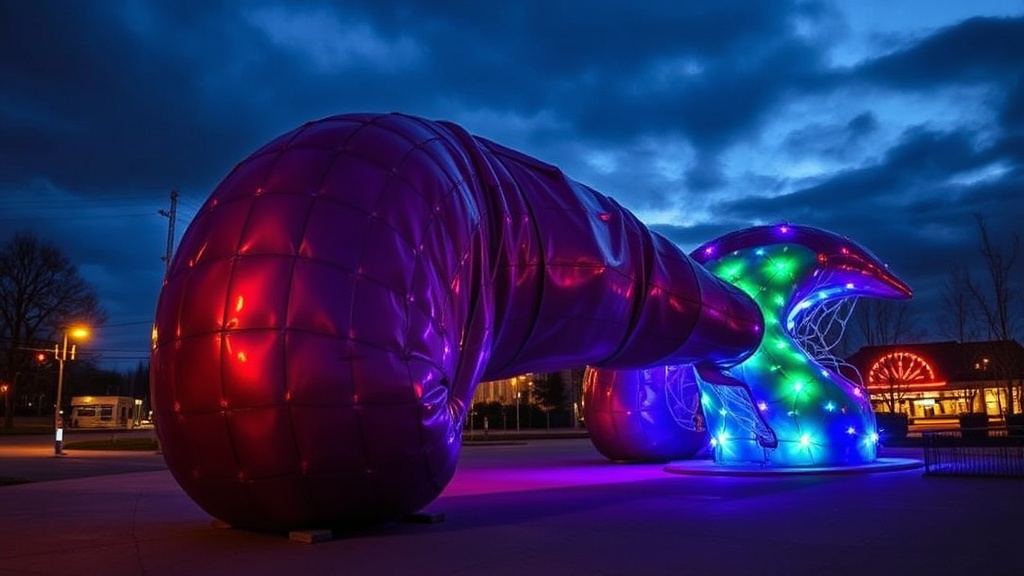
Tucked behind the industrial buildings near Rue de l'Industrie, three massive metal sculptures rise from the ground like abstract mechanical flowers. Most people drive right past them on their way to the commercial district, which is a shame — these pieces represent one of the most ambitious public art initiatives Rouyn-Noranda has undertaken.
Created by metalworker Jean-Pierre Lefebvre using salvaged equipment from the now-closed mines, the sculptures transform industrial waste into something unexpectedly elegant. Lefebvre worked with retired miners to identify historically significant machinery pieces, then arranged them into forms that suggest both decay and growth. The rust is intentional — the artist wanted viewers to see time's effect on materials that once seemed permanent.
The city acquired these works in 2015 and placed them in this somewhat hidden location to create what cultural planners call a "discovery experience." Finding them feels like stumbling onto a secret, which makes the encounter more memorable than if they sat in a obvious plaza. Pack a coffee from your favorite local spot and spend twenty minutes walking around them — the way light hits the metal at different times of day genuinely changes the viewing experience.
Which Downtown Installation Honors Our Franco-Ontarian Roots?
In the plaza outside the Cégep de l'Abitibi-Témiscamingue, a series of engraved stone pillars stands arranged in a semi-circle, each bearing quotes from Franco-Ontarian writers, musicians, and community leaders who shaped this region's cultural identity. The installation, titled "Voix du Nord," debuted in 2017 and immediately became a gathering spot for students and locals alike.
The quotes aren't random selections — they're specifically tied to Rouyn-Noranda's role as a hub for Franco-Ontarian cultural production. You'll find passages from authors who wrote here, lyrics from musicians who recorded in local studios, and statements from activists who organized in our community halls. The stones themselves came from a quarry that supplied building materials for many of our city's earliest structures, creating another layer of local connection.
What makes this installation work is its interactivity. Unlike a traditional statue that you observe from a distance, these pillars invite you to walk between them, touch the engraved text, and literally move through the history they represent. On sunny afternoons, you'll often find people sitting on the low stone benches built into the structure, reading or talking. That's public art functioning exactly as it should — as infrastructure for community life rather than decoration imposed upon it.
How Did Rouyn-Noranda's Street Piano Project Start?
If you've spent any time in our downtown core during summer months, you've heard the street pianos — painted uprights placed at strategic corners, available for anyone to play. The program started in 2016 with three instruments and has expanded to seven locations across Rouyn-Noranda, each one decorated by a different local artist.
The concept is simple but effective: take pianos that were destined for landfills, refurbish them, paint them with designs reflecting local themes (one features imagery from Lake Osisko, another depicts the mining headframes), and chain them to permanent structures in high-foot-traffic areas. The result is spontaneous music floating through our streets — everything from Chopin played by conservatory students to improvised blues by retirees to children banging out their first attempts at melodies.
Maintenance falls to a volunteer network organized through the city's cultural department. They tune the instruments monthly during summer and cover them with weatherproof tarps when rain threatens. If you've ever wondered who keeps these pianos sounding decent — it's your neighbors, donating time because they believe public music matters. The program has inspired similar initiatives in other Abitibi-Témiscamingue communities, but Rouyn-Noranda's version remains the most extensive in the region.
What Makes the Airport Installation Unexpectedly Moving?
Most small-city airports feature generic landscapes or abstract geometric designs. Rouyn-Noranda's airport terminal contains something different: a suspended sculpture of 847 copper birds — one for each day the region's first mine operated before its initial closure.
Artist Marie-Claude Gagnon spent eighteen months creating this piece, hand-shaping each bird from locally sourced copper to ensure the material connection to our mining heritage remained authentic. The birds appear to fly through the terminal's atrium in a swirling formation that suggests both migration and return — a fitting metaphor for an airport, but also for the waves of workers who came to Rouyn-Noranda seeking opportunity and made it home.
The installation rewards extended viewing. From a distance, it reads as a single cohesive form, but as you move through the space, individual birds come into focus, each slightly different from its neighbors. Gagnon has said she wanted to suggest that community consists of distinct individuals creating something larger through collective action. Standing beneath the sculpture with your luggage, waiting for a flight or greeting arriving family, you feel that message viscerally. It's public art that actually works with its environment rather than merely occupying it.
Which Neighborhood Murals Tell Immigrant Stories?
The Evain district contains several building murals that document the experiences of immigrants who built Rouyn-Noranda's working-class neighborhoods. These aren't officially commissioned pieces — they grew from a 2014 community art project where recent immigrants collaborated with established local artists to create visual narratives of their journeys.
The largest mural covers the back wall of a grocery store on Rue Principale. It depicts a composite scene showing families arriving by train (the primary entry point for early 20th-century immigrants to our region), finding housing in the boarding houses that once lined these streets, and establishing the small businesses that still serve the neighborhood today. The artists incorporated photographs and documents contributed by local families, making the mural a genuine community archive rendered in paint.
What's remarkable is how the murals have been maintained. When weather damage threatened one piece in 2019, neighborhood residents organized a fundraising campaign and restoration effort without waiting for municipal intervention. That kind of grassroots stewardship speaks to how deeply these images matter to the people who live with them daily. The art belongs to the community in a way that more prestigious, professionally managed installations sometimes don't.
Why Does the Industrial Park Have a Poetry Trail?
This one's genuinely strange in the best way — along the walking path connecting the industrial park to the residential neighborhood of Noranda, metal plaques embedded in the ground display poems by local writers. The installation, called "Pas à pas" (Step by Step), places literature directly in the path of people who aren't necessarily seeking it out.
The poems address themes relevant to industrial life: labor, exhaustion, community solidarity, the tension between economic necessity and environmental concern. Some were written specifically for this installation; others were selected from existing work by Rouyn-Noranda poets. All appear in both French and English, reflecting our city's bilingual reality.
The physical placement matters. By embedding the texts in the ground rather than posting them at eye level, the designers force you to look down — literally ground-level perspective — while walking through a landscape dominated by industry. The experience creates unexpected cognitive dissonance: poetry amid factories, contemplation during commute. It's precisely the kind of conceptual public art that wouldn't work everywhere, but feels right for Rouyn-Noranda, where we've always combined practical labor with cultural production more than outsiders expect.
Our public art isn't perfect — some pieces feel dated, others were poorly maintained during budget cuts, and the selection process sometimes generates legitimate debates about whose stories get told and how. But taken together, these seven installations (and dozens more scattered throughout our neighborhoods) demonstrate that Rouyn-Noranda takes its cultural identity seriously. We invest in permanent creative works that root us in specific history rather than generic placelessness. Next time you're walking to work, picking up groceries, or waiting for a flight, look around — there's probably something nearby that an artist made specifically for this community, at this moment, in this place we share.